

Repairing a board takes
more than a soldering iron.
Getting a faulty component off without damaging the board is where repair work is won or lost — and that needs hot air, vacuum desoldering or tweezers, not an iron. Twelve ATTEN systems, from a €79 hot air station to a four-tool bench with the vacuum generator built in.
How many tools do you need on the bench?
That single question sorts this whole category. A hot air gun lifts surface-mount parts; a vacuum gun clears through-hole joints; tweezers take small two-lead components off in one move. Buy for the work you actually do, not the work you might.
Hot air only
One tool: a heat gun with controlled temperature and air. The starting point for SMD rework, shrink tubing and lifting components.
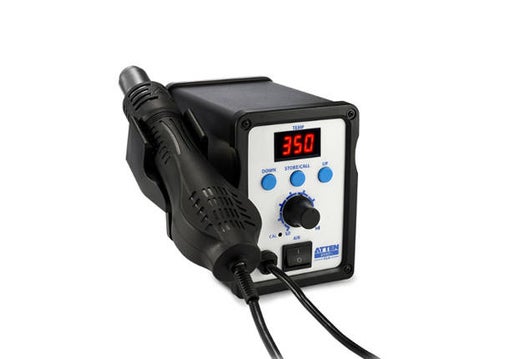
AT858D+
€79,00The cheapest way to get hot air on the bench. Closed-loop MCU control, an LED read-out and a fan pump with 75 steps of air.
- Auto-sleep sensor in the gun handle
- Air in grades A25 – A99
- Cool-down blow protects the element
- Under 52 dB(A)
- Three nozzles in the box
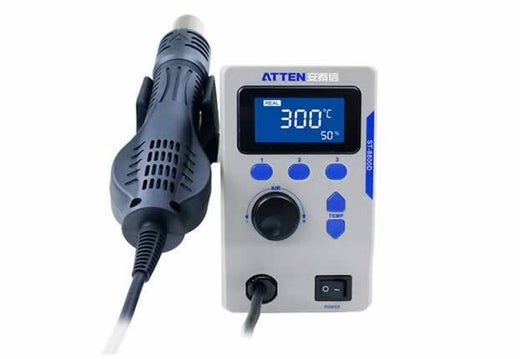
ST-8800D
€105,00A compact 800 W station with proper diagnostics: it names the fault on screen instead of just refusing to heat.
- Three shortcut temperature / air presets
- Sensor and heater faults shown as S-E / H-E
- Temperature compensation ±50 °C
- Standby heater cooling
- 167 × 142 × 148 mm, 1.56 kg
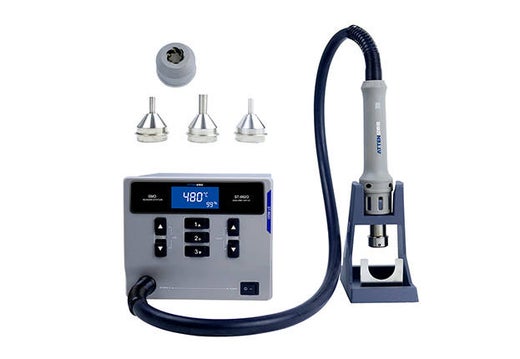
ST-862D
€185,00The one that gets used all day. A brushless fan, a heater you can unplug and replace in seconds, and a straight-or-spiral air choice.
- Brushless fan, high volume
- Pluggable heater — no soldering to replace it
- Convertible straight air / spiral air
- Temperature lock and timed work
- 45° nozzles available separately
2-in-1 — iron and hot air
Hot air plus a soldering iron in one chassis, sharing a screen and a footprint. The obvious choice when bench space is the constraint.
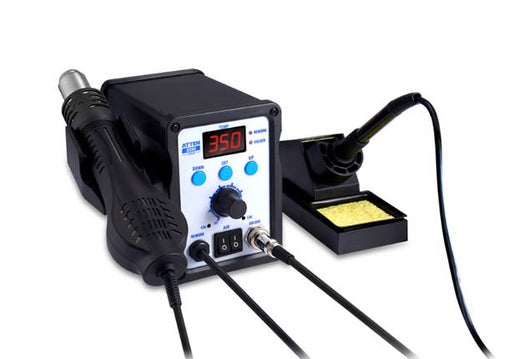
AT8586
€109,00Hot air and a 50 W iron in one compact box. The low-voltage iron heater keeps the tip safe for sensitive parts.
- 50 W soldering iron, ±1 °C stability
- Low-voltage heater, ESD-friendly
- Iron takes the common T900 tips
- Auto-sleep on both tools
- Three nozzles + iron stand included
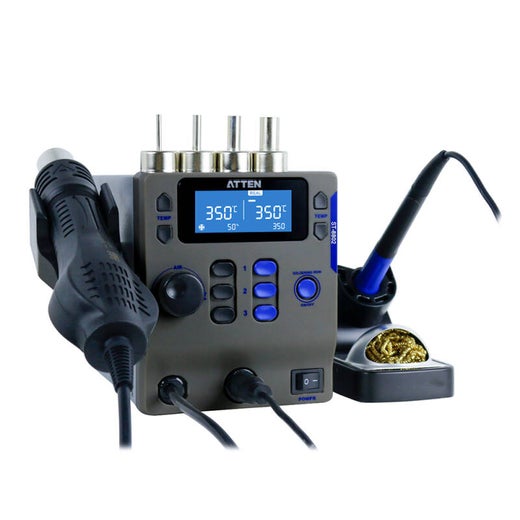
ST-8802
€165,00The step up from the AT8586: a large LCD, a vortex fan that spreads the air instead of blasting it, and a real cold-air mode.
- Iron 65 W, 80 – 480 °C, ±2 °C stability
- Brushless vortex fan — gentler, more even air
- AP-800B air handle, SP-65 iron handle
- Ships with a T900-B tip and four nozzles
- Touch sensor auto-sleep in the gun stand
- Independent cold-air function
- Password protection and key lock
Multi-tool benches
Three or four tools in one unit, with a bench power supply on the MS300 and MS500. A complete repair station rather than an appliance.
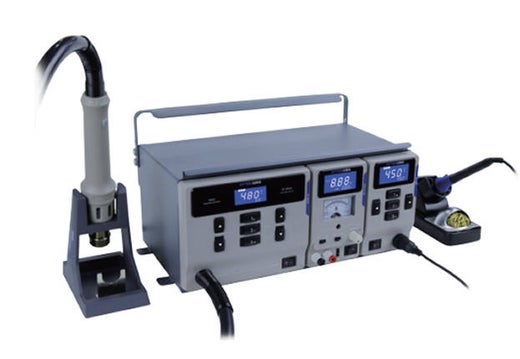
MS300
€350,00A whole repair bench in one chassis: the ST-862D hot air station, an ST-965 60 W soldering station and a dual-range DC supply.
- Hot air module: ST-862D
- Soldering module: ST-965 60 W (T900 tips)
- Supply: APS15-3A, 0 – 5 V / 0 – 15 V, 0.5 A / 5 A
- Independent USB output, 2.1 A, protected
- OCP and over-temperature protection
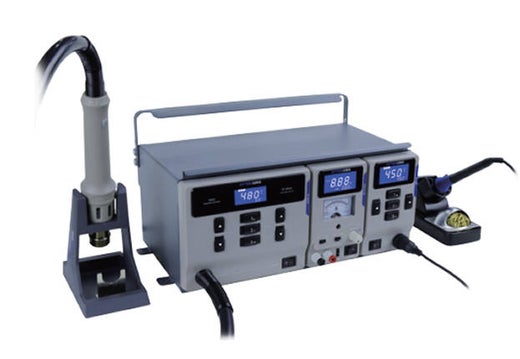
MS500
€420,00The MS300 idea with more behind it — a 150 W soldering module and a 125 W laboratory supply, in a rack frame you can move.
- Hot air module: ST-862D, 1000 W
- Soldering module: ST-9150 150 W (T9150 cartridges)
- Supply: APS22-5A, 0 – 22 V, 0.5 A / 5 A, 125 W
- Idle drop to 80 °C extends tip life
- Rack kit for transport and installation
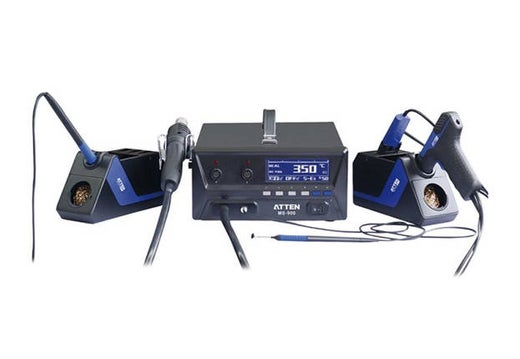
MS900
€1.069,00Four tools on three independent channels, with the vacuum generator built in. This is the one for a repair shop that takes boards apart as often as it puts them together.
- Hot air 550 W · iron 130 W · desoldering 150 W · tweezers 100 W
- Three channels, no interference between them
- Built-in vacuum generator — no external pump
- ±2 °C stability on every tool
- Graphic display, automatic tool identification
GT intelligent systems
A station that reads which tool you plug in and loads its parameters. Buy the base once, add handles as the work demands.
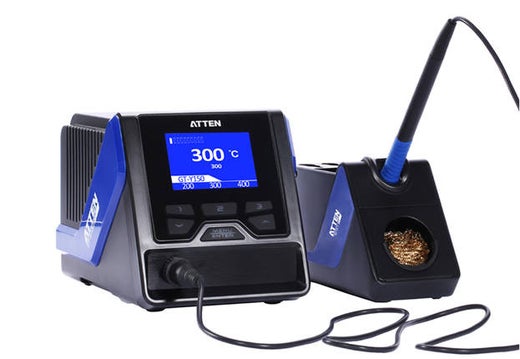
GT-6150
€279,00One channel, but it recognises whatever GT tool you plug into it and loads that tool's parameters — iron today, tweezers tomorrow.
- Automatic tool recognition
- Graphic display of every parameter
- Three preset temperature groups
- Stand-by and auto-sleep
- Takes GT-Y050 / GT-Y130 cartridges
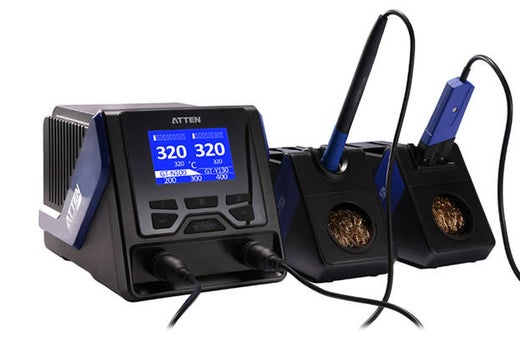
GT-6200
€587,00Two channels running at once, and the iron and hot tweezers are both in the box. Put the tweezers down and pick up the iron without changing anything.
- Two independent channels, 150 W each
- GT-Y130 iron + GT-N100 hot tweezers included
- Automatic tool recognition
- Three preset temperature groups
- 8.1 kg — it stays where you put it
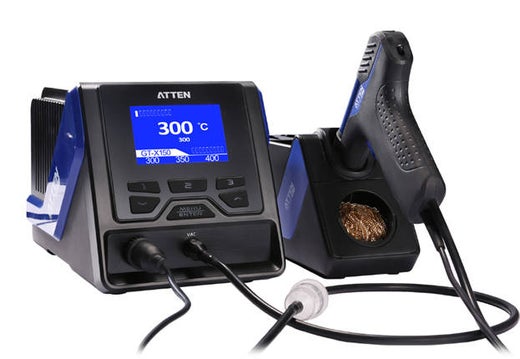
GT-5150
€469,00A dedicated vacuum desoldering station. For through-hole work it beats hot air and braid outright: the joint melts and the solder leaves in one motion.
- Built-in vacuum pump at −600 mmHg
- GT-X150 desoldering gun in the box
- Takes T151 nozzles, 0.8 – 1.6 mm bore
- Automatic tool recognition
- Accepts GT-Y iron handles as a second tool
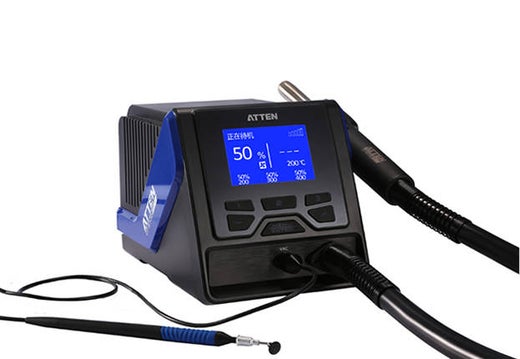
GT-8102
€499,00A 1000 W hot air rework station with a vacuum pick-up pen on the side, so the part you just released comes straight off the board.
- 1000 W heating core, fast to temperature
- Brushless fan, up to 120 l/min
- Vacuum suction pen included
- Timed and manual heating modes
- Three air / temperature shortcut sets
- Password protection on the settings
All 12 systems compared
A dash means ATTEN does not publish that figure for the model — we would rather leave it blank than fill it in. Prices include VAT.
| Model | Tools | Power | Temperature | Air / vacuum | Price |
|---|---|---|---|---|---|
| AT858D+ | Hot air | 700 W | 100 – 500 °C | up to 120 l/min | €79,00 |
| ST-8800D | Hot air | 800 W max | 100 – 500 °C | 30 – 120 l/min | €105,00 |
| ST-862D | Hot air | 1000 W | 100 – 480 °C | 30 – 120 l/min | €185,00 |
| AT8586 | Hot air, Soldering iron | 750 W total | 150 – 480 °C (iron) | A25 – A99 | €109,00 |
| ST-8802 | Hot air, Soldering iron | 800 W air + 65 W iron | 100 – 500 °C (air) | 120 l/min | €165,00 |
| MS300 | Hot air, Soldering iron, DC power supply | — | 100 – 480 °C (air) | up to 120 l/min | €350,00 |
| MS500 | Hot air, Soldering iron, DC power supply | 1000 W (air) | 100 – 480 °C (air) | 30 – 120 l/min | €420,00 |
| MS900 | Hot air, Soldering iron, Vacuum desoldering, Hot tweezers | 900 W total | 150 – 500 °C | 23 l/min | €1.069,00 |
| GT-6150 | Soldering iron | 150 W max | 150 – 480 °C | — | €279,00 |
| GT-6200 | Soldering iron, Hot tweezers | 200 W (150 W per channel) | 150 – 480 °C | — | €587,00 |
| GT-5150 | Vacuum desoldering | 150 W | 250 – 480 °C | −600 mmHg vacuum | €469,00 |
| GT-8102 | Hot air, Vacuum pick-up pen | 1000 W max | — | up to 120 l/min | €499,00 |
Four ways to get a part off a board
Most rework mistakes are the wrong tool rather than the wrong technique. Here is what each one is genuinely good at.
Hot air
Heats a whole package at once. The tool for QFPs, BGAs, shield cans and anything with more leads than you can reach. Watch the air, not just the temperature — too much blows the neighbours off.
Vacuum desoldering
Melts a through-hole joint and pulls the solder out of the plated hole in one motion. Nothing else clears a 40-pin connector without lifting pads.
Hot tweezers
Heats both ends of a two-lead part simultaneously and lifts it off. For 0402s and small SOICs it is faster and far gentler than hot air.
The soldering iron
Still what puts the board back together. On a rework system it matters that the iron is not an afterthought — check the wattage and which tip series it takes.
Nozzles, tips and spares
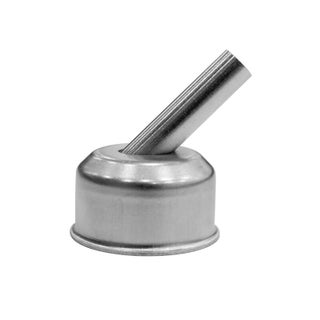
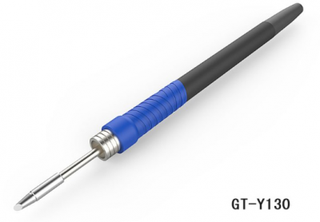
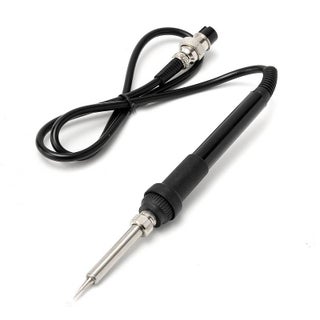
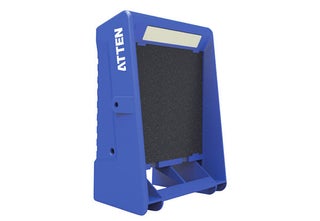
A rework station is only as good as the nozzle on the gun and the tip in the iron. We stock both, plus the heating elements and filters, so a station stays in service.
Tell us what you repair
Phones and tablets, industrial boards, automotive modules or classic through-hole gear — they each point at a different system. Describe the work and we will tell you which of the twelve fits, and which nozzles and tips to order with it.
MS300, MS500 or MS900 — what is the difference?
All three put several tools in one chassis. The MS300 (€350) is hot air, a 60 W iron and a 0–15 V supply. The MS500 (€420) keeps the same hot air module but steps the iron up to a 150 W ST-9150 and the supply up to 0–22 V / 125 W, in a rack frame. The MS900 (€1.069) drops the power supply and adds what a repair shop actually needs instead: vacuum desoldering and hot tweezers, on three independent channels with the vacuum generator built in.
Do I need hot air or a vacuum desoldering gun?
They solve different problems. Hot air is for surface-mount — it heats a whole package at once so you can lift a QFP or a shield can. A vacuum desoldering gun is for through-hole: it melts the joint and sucks the solder out of the plated hole in one motion, which hot air and braid struggle with. If you work on older boards, connectors and power sections, the GT-5150 or the MS900 will save you more time than another hot air station.
How much air flow do I actually need?
More than you think for large packages, less than you think for small ones. Around 120 l/min is enough to bring a shield can up to temperature; the problem with a lot of air is that it moves the small parts next to the one you are working on. That is why the ST-8802's vortex fan and the ST-862D's spiral-air setting matter more than the peak number — a gentle, even flow at the right temperature beats a blast.
Which tips and nozzles does each system take?
The AT8586's iron takes T900 tips, as does the MS300 (its module is an ST-965). The MS500's ST-9150 takes T9150 cartridges. The GT stations take GT-Y cartridges, the GT-N100 tweezers take T9100 pairs and the GT-X150 gun takes T151 nozzles. Hot air nozzles are in the A-11, A-16, A-21 and A-26 series, with dedicated 45° nozzles for the ST-862D.
Is a 2-in-1 better than two separate stations?
For bench space, yes. For throughput, not always: on a 2-in-1 the iron and the gun share one controller and one screen, so you set one tool at a time. If two people use the bench, or you switch between air and iron constantly, separate units or a GT dual-channel station will annoy you less.
What is covered by the warranty?
Two years on the systems themselves. Nozzles, tips, heating elements and filters are wear parts and sit outside it — we keep those in stock as spare parts so a station stays in service instead of being replaced.