

Regulated DC power
from 90 W to 900 W.
Seven ATTEN bench supplies for test, repair and development work: programmable units delivering up to 31 V and 31 A, three-channel isolated linear supplies for laboratory use, and single-channel linear benches with ripple below one millivolt. The section below explains which type suits which application.
Linear, switching, or both at once?
This is the only decision that matters in this category, and it comes down to a trade you cannot avoid: a regulator that is electrically quiet wastes the difference as heat, and one that is efficient does it by switching — which makes noise.
Linear
Burns the difference between input and output as heat. Heavy, inefficient, and very quiet — half a millivolt of ripple. Buy it if the supply sits behind something you are measuring.
Switching
Chops the input at high frequency instead of burning it. Light, efficient, and capable of real current — 30 A from a pure linear supply would weigh what a car battery does. The cost is ripple.
Both — the CP series
A switching pre-regulator with a linear post-regulator behind it. The switcher does the heavy lifting; the linear stage cleans up after it. That is how you get 31 A and 10 mVrms in the same box.
CP series — programmable, 30 A
€500A switching pre-regulator followed by a linear post-regulator: the current and efficiency of a switcher with much of the ripple taken back out again. 31 V and 31 A on tap, USB and RS232, and hardware protection on every axis. This is the repair-bench supply.
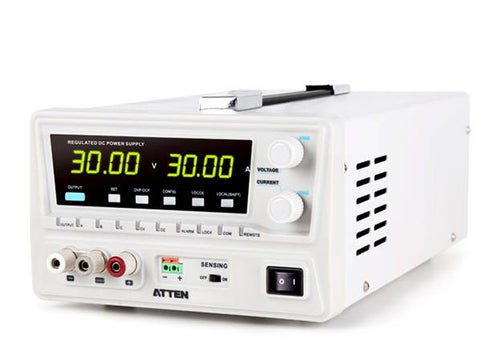
CP600
€500,00The 600 W CP, and the only supply here with a true constant-power mode as well as CV and CC — it will hold the wattage as the load's impedance moves.
- CV / CC / CP — constant power as a third mode
- 1 mV / 1 mA setting resolution, 16-bit DAC and 20-bit ADC
- Remote voltage sense with automatic compensation
- Hardware OVP, OCP, OHP, OPP and short-circuit protection
- Three memory groups for instant recall
- 100 – 265 V AC input, PFC > 0.98, efficiency ≥ 85%
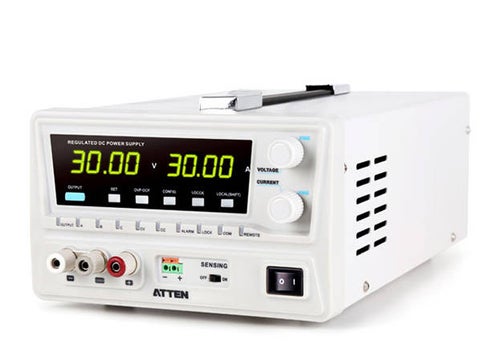
CP900
€500,00Same chassis and the same 31 V / 31 A envelope as the CP600, with half again the power budget — so it holds full current further up the voltage range.
- 900 W, CV / CC
- 1 mV / 1 mA setting resolution, 16-bit DAC and 20-bit ADC
- Remote voltage sense with automatic compensation
- Hardware OVP, OCP, OHP, OPP and short-circuit protection
- Three memory groups for instant recall
- 100 – 265 V AC input, PFC > 0.98, efficiency ≥ 85%
PR35 series — three-channel linear
€620 – €680Three isolated channels in one box, series or parallel at one button press. For a lab or a training bench where one supply has to feed a split rail and a logic rail at the same time.
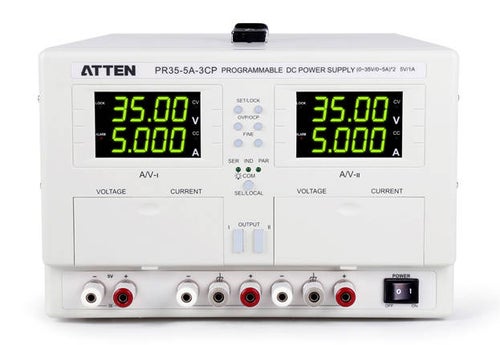
PR35-3A-3C
€620,00Three fully isolated channels — two main outputs and a small fixed one — that series or parallel at the press of one button, with no patch leads across the front panel.
- Channels: 105 W + 105 W + 5 W
- Three completely isolated outputs
- Series / parallel by one button, no external wiring
- Four digital displays
- Ripple 0.5 mVrms, transient response 50 µs
- Flip-down panel cover stops accidental adjustment
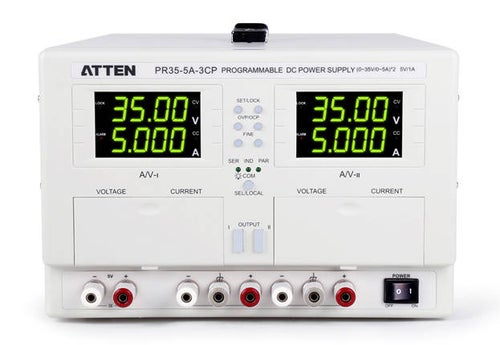
PR35-5A-3C
€680,00The 5 A version of the same three-channel bench supply: 175 W on each of the two main channels instead of 105 W.
- Channels: 175 W + 175 W + 5 W
- Three completely isolated outputs
- Series / parallel by one button, no external wiring
- Four digital displays
- Ripple 0.5 mVrms, transient response 50 µs
- Flip-down panel cover stops accidental adjustment
TPR series — single-channel linear
€122 – €165Classic analogue series regulators. Heavier and less efficient than a switcher, and far quieter electrically — sub-millivolt ripple, which is what you want behind anything you are trying to measure.
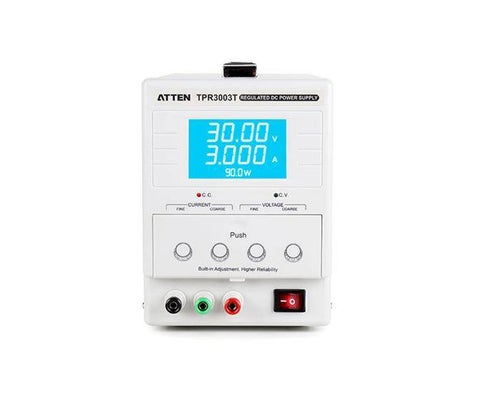
TPR3003T
€159,00The quiet one. A pure analogue series regulator with 0.5 mVrms of ripple — twenty times cleaner than the switching supplies — for anything where noise on the rail would show up in the measurement.
- Ripple and noise ≤ 0.5 mVrms (5 Hz – 1 MHz)
- Seamless automatic CV / CC switching
- LCD with dual 4-digit meters and calculated power read-out
- Rated for continuous full-load use
- Double-ball-bearing fan
- Panel door cover prevents mis-adjustment
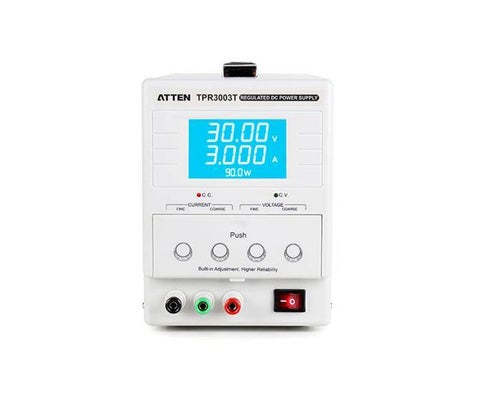
TPR3005T
€165,00The same supply with 5 A instead of 3 A, for €6 more. Unless you are certain 3 A is enough, this is the one to buy.
- Ripple and noise ≤ 1 mVrms (5 Hz – 1 MHz)
- Seamless automatic CV / CC switching
- LCD with dual 4-digit meters and calculated power read-out
- Rated for continuous full-load use
- Double-ball-bearing fan
- Panel door cover prevents mis-adjustment
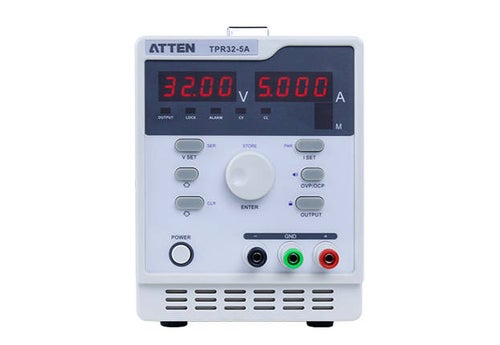
TPR32-5A / TRR75-2A
€122,00MCU-controlled and RS232-programmable, with ten stored setups and master-slave series/parallel expansion. Sold as one listing covering two variants — tell us which you need.
- Ten memory presets, including OVP and OCP values
- RS232 for computer control
- External control mode — drive V and I from an external voltage
- Master-slave series and parallel expansion
- External monitoring outputs for a higher-precision meter
- Status lock and alarm
All 7 compared
Watch the ripple column — it is the difference between the two families, and it spans a factor of twenty. A dash means ATTEN publishes no figure for that model. Prices include VAT.
| Model | Type | Ch | Voltage | Current | Power | Ripple | Interface | Price |
|---|---|---|---|---|---|---|---|---|
| CP600 | Switching + linear | 1 | 0 – 31 V | 0 – 31 A | 0 – 600 W | 10 mVrms | USB · RS232 | €500,00 |
| CP900 | Switching + linear | 1 | 0 – 31 V | 0 – 31 A | 0 – 900 W | 10 mVrms | USB · RS232 | €500,00 |
| PR35-3A-3C | Linear | 3 | 0 – 35 V | 0 – 3 A | 215 W total | 0.5 mVrms | — | €620,00 |
| PR35-5A-3C | Linear | 3 | 0 – 35 V | 0 – 5 A | 175 + 175 + 5 W | 0.5 mVrms | — | €680,00 |
| TPR3003T | Linear | 1 | 0 – 30 V | 0 – 3 A | 90 W | ≤ 0.5 mVrms | — | €159,00 |
| TPR3005T | Linear | 1 | 0 – 30 V | 0 – 5 A | 150 W | ≤ 1 mVrms | — | €165,00 |
| TPR32-5A / TRR75-2A | Linear, programmable | 1 | — | — | — | — | RS232 | €122,00 |
Four benches, four answers
Phone & board repair
Set a current limit, watch what the board draws, find the short. You want amps and a fast, accurate current read-out — the CP series.
R&D and analogue
Ripple on the rail lands in your measurement. A linear TPR at 0.5 mVrms keeps the supply out of the result.
Split rails
Op-amp circuits want ±15 V and a logic rail at the same time. Three isolated channels and a series button — the PR35.
Education & training
Short-proof, current-limited, with a panel cover so settings survive the next class. The TPR benches were designed for exactly this.
The rest of the bench
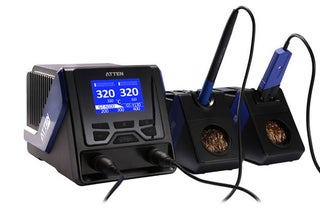
Tell us what you are powering
Voltage, current and whether anything sensitive is downstream — that is enough for us to point at the right supply. For training rooms and production benches we quote in quantity.
Linear or switching — which do I need?
Linear if the supply sits behind something you are measuring: audio, RF, sensors, anything analogue. A linear regulator burns the difference between input and output as heat, which makes it heavy and inefficient but electrically very quiet — the TPR supplies manage 0.5 mVrms. Switching if you need real current: a switcher is light and efficient, and 30 A from a linear supply would be the size of a small car battery. The CP series splits the difference by putting a linear stage after the switching stage.
What is the difference between the CP600 and the CP900?
Power budget, and one mode. Both cover 0–31 V and 0–31 A with identical regulation figures, but the CP600 is rated 600 W and the CP900 900 W — so the CP900 holds full current further up the voltage range before it runs out of headroom. The CP600 also lists a constant-power mode (CV/CC/CP) where the CP900 is CV/CC. Both are currently listed at the same price, so ask us before ordering.
What does constant power actually do?
In CV the supply holds volts and lets current vary; in CC it holds current and lets volts vary. In CP it holds the product — as the load's impedance changes, voltage and current move together to keep the wattage where you set it. It is used for battery and ageing tests, and for anything specified in watts rather than volts.
Can I put channels in series or parallel?
On the PR35 supplies, yes, and without patch leads — the three channels are fully isolated and one button switches them into series or parallel. The TPR32-5A supports master-slave series and parallel expansion between separate units. Series gets you more voltage, parallel more current.
Why does ripple matter?
Ripple is the AC left on top of the DC. It rides straight through into whatever you power, so it lands in your measurement — as noise on a scope trace, a raised noise floor on an analyser, or hum in audio. A linear supply at 0.5 mVrms is roughly twenty times quieter than the switching CP series at 10 mVrms. For digital work it rarely matters; for analogue work it decides the result.
Are these supplies covered by the warranty?
Two years, as with the rest of the ATTEN equipment range. The one-year term applies to soldering handles, which are not part of this category.