

T10 Series Soldering Tips
Cartridges for the GT-2010 USB soldering iron.
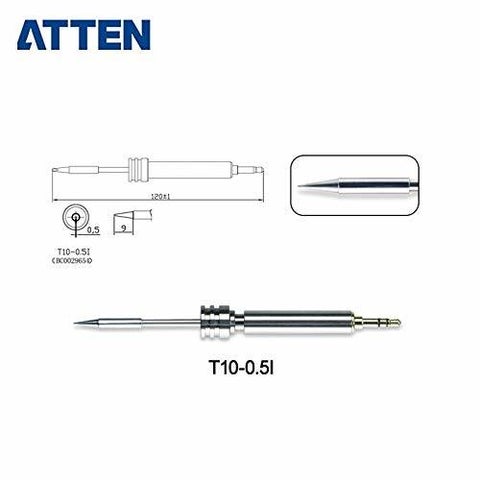
Pictured: T10-0.5I — one of 6 shapes in the series.
Fits these ATTEN tools
Confirmed from the GT-2010 page, which links to this series for replacement tips.
About the T10 series
The GT-2010 runs off USB-C, so everything has to be small and efficient — heater, sensor and tip are one short cartridge. Six shapes, from a 0.5 mm needle to a 3.0 mm chisel, cover portable repair work.
All 6 T10 tips
Sorted from the finest point to the widest face. Prices include VAT.
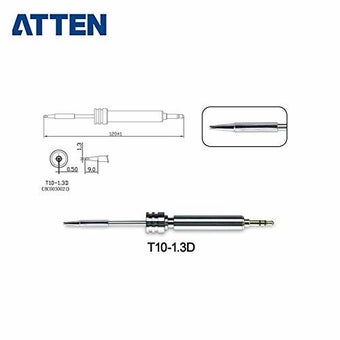
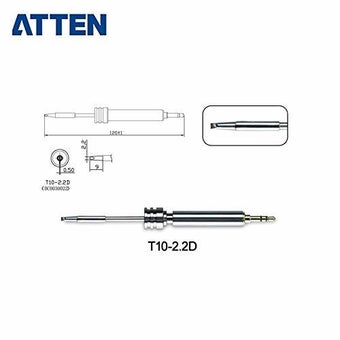
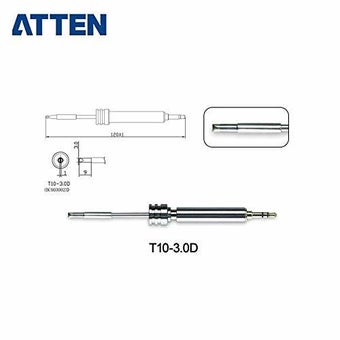
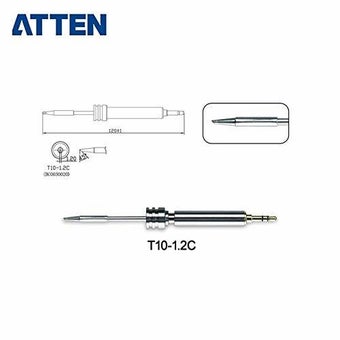
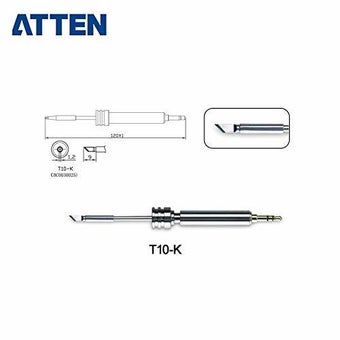
The shapes in the T10 series
An ATTEN code is series – size – shape. In T900-2.4D: T900 is the fitting standard, 2.4 is the width of the working face in millimetres, and D is the shape.
A very fine conical point. Fine-pitch SMD, 0402 and smaller, and touching up a single pad.
A flat screwdriver face. The most versatile shape — the best heat transfer per millimetre of contact.
A cylinder cut at an angle. Holds a bead of solder, so it is the shape for drag soldering and larger pads.
A blade edge. Made for dragging along a row of pins and for clearing solder bridges.
Bigger is usually better
The instinct with fine work is to reach for the finest tip. It is usually the wrong call: a needle has almost no thermal mass, so it cools the moment it touches a pad and you end up leaning on the joint for seconds, which is what actually lifts pads and cooks components.
Pick the largest tip that still fits the joint. A 2.4 mm chisel will solder 0.5 mm-pitch QFP pins far more happily than a 0.5 mm needle, because it carries enough heat to make the joint in under a second.
A knife (K) or a 1.6–2.4 mm chisel. Flood the pins with flux and drag — do not try to do them one at a time with a needle.
This is where a needle (I) or a small bevel (C) earns its place — when the neighbouring parts genuinely leave no room.
A 2.4–3.2 mm chisel (D) covers almost all of it. Conical (B) if you need to get down into a crowded header.
4.6 mm and up, and a station with the wattage behind it. Heat has to arrive faster than the copper carries it away.
Why tips die, and how to stop it
A soldering tip is iron-plated copper. Nothing wears it out faster than heat with no solder on it — so most of tip life is really a habit problem.
Turn the heat down
Work at the lowest temperature that still wets the joint. Every extra 50 °C roughly halves the life of the iron plating.
Never park it dry
Leave a bead of solder on the tip whenever it goes back in the stand. A bare hot tip oxidises in seconds and then stops taking solder.
Brass, not a wet sponge
Brass wool cleans without thermal-shocking the plating. A wet sponge drops the tip 100 °C every wipe and cracks the coating over time.
Don't file it
Filing or sanding a dewetted tip removes the iron plating and exposes the copper underneath. Once that happens the tip dissolves into the solder.
Handles, tweezers and cleaners
A tip that will not wet is often a tired handle or a dirty tip rather than a worn face.
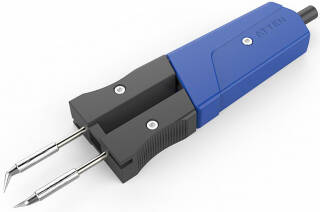
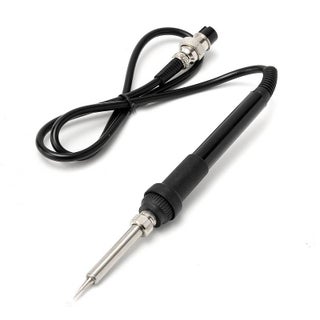
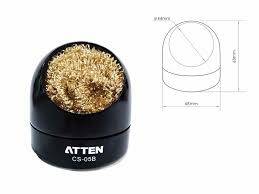
Not sure which tip fits your iron?
Send us the model number of your station or handle — it is printed on the front panel or moulded into the grip — and we will tell you which series to order. It takes us a minute and saves you a return.
How do I read the code, for example T10-0.5I?
The code is series–size–shape. The first part is the fitting standard, the number is the width of the working face in millimetres and the last letter is the shape — C for bevel, D for chisel, B for conical, I for needle, K for knife.
Will a T10 tip fit my station?
It fits GT-2010 USB soldering iron. If your model is not in that list, mail info@atten.eu with the model number and we will confirm before you order.
Which size should I buy?
The largest one that still fits the joint. A bigger face carries more heat, so the joint is made in under a second instead of you leaning on it — that is what protects pads and components.
How long does a tip last?
Anywhere from weeks to years, depending almost entirely on temperature and on whether the tip is left dry in the stand. Work at the lowest temperature that wets the joint and always park the iron with solder on the face.